
The first mistake Nora Vale made that night was reaching for the good wineglass. There were two kinds laid out for dinner at the Bellwether, and if you held them side by side you could see how much more of the light the expensive one kept. The ordinary glass was thick enough to knock against a plate without much consequence. The special one had a stem so fine you could feel it bend, or think you could, if you polished it too vigorously. The manager had told Nora to bring three of those glasses to table six. She had said it without looking up from the seating chart.
Nora had worked two events at the restaurant before, both brunches. They each ended while it was still light outside. She had forgotten how many people in a banquet room could make real darkness out of the space behind a curtain. When you went behind the heavy curtain at the Bellwether, you had about ten feet of dim floor before you hit the brightest room in the building, a service passage with fluorescent tubes and plastic racks you could almost see through. On her first night shift, Nora had already learned which tiles gave a hollow sound and which connection to the kitchen carried the smell of bread.
Nora had taken the shift because the bookstore where she worked most afternoons had stopped opening on Tuesdays. The owner said they might bring Tuesdays back when the college students returned. Nora did the math on the back of a gas receipt, called the restaurant, and told her sister that the new work would be a good way to meet people. The part she didn’t say was that she liked having instructions she could follow. At the bookstore you spent a great deal of time deciding whether somebody who had put a hand on the door was looking for help. At the Bellwether there were written instructions for how far a folded napkin should be from a knife. If you were careful enough, everybody got a fair chance to do something well.
The event was a dinner for people who raised money to repair old buildings. There were architects, retired teachers, and a couple who had spent twenty years trying to keep a small cinema from being converted into a parking garage. Someone had placed a photograph of the cinema on every table. Nora was supposed to bring three extra wineglasses because the couple had asked to sit with friends. She lined them up on a tray and breathed deliberately through her nose the way she’d been taught. She had seen Lydia, the manager, slip a folded napkin beneath a glass to quiet its stem, and she did it exactly as Lydia had.
When Nora pushed back the curtain, a catering trolley stood skewed across half the opening. It was stacked with used plates and had a canvas cover clipped high on one corner. Rosa Delgado, the banquet porter, was trying to move it back into the service passage. Nora knew Rosa well enough to recognize the breath she took before moving a heavy load, the practiced stillness in her upper body while she set both feet.
"Can you get around me?" Rosa asked.
Nora thought she could. There was the length of a shoe and a little more between the trolley and the curtain, enough if she held the tray out in front. She had already passed both shoulders through when the trolley moved an inch in the wrong direction. Something made a hard, hollow click. The edge of the top shelf brushed her tray. Two glasses leaned into her fingers. The third made it as far as the lip before it fell. It broke on the strip of bare stone outside the carpet, scattering the pieces in a narrow fan.
For about one second, nobody moved. Then Nora stepped back, told a guest to watch his shoes, and asked Rosa to bring a dustpan. The guest was already holding a chair up so it could be moved out of the way. Nora thought the mishap might go by with nothing worse than a joke from the guest about what it cost to stand too close to a wineglass. Then Lydia arrived, lifting the curtain between two fingers as though somebody had left a fingerprint there.
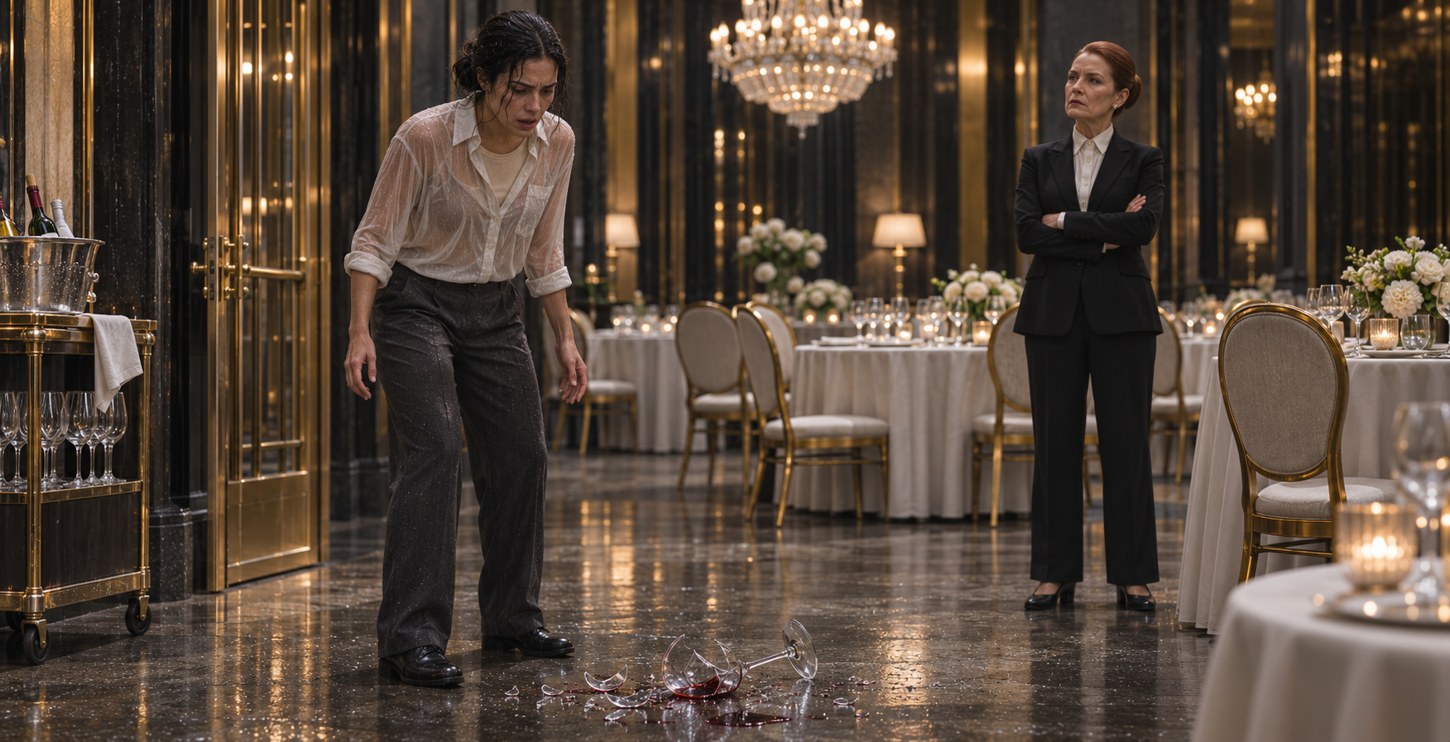
"What happened?"
"I broke a wineglass," Nora said. "I’ll sweep it up."
Lydia took the tray out of her hands. She turned toward the closest table and said the noise came from the kitchen. The guests went back to their conversations. She told Rosa to finish collecting the plates, and with her chin she indicated the far end of the passage. Nora followed her. It felt like moving backstage at a school concert, when you could hear a performance going on without you and had to be quiet until it was your turn again.
"Where do you think you’re going?" Lydia asked when Nora stopped beside the employee station.
"I have to get a broom."
"You go out the other door."
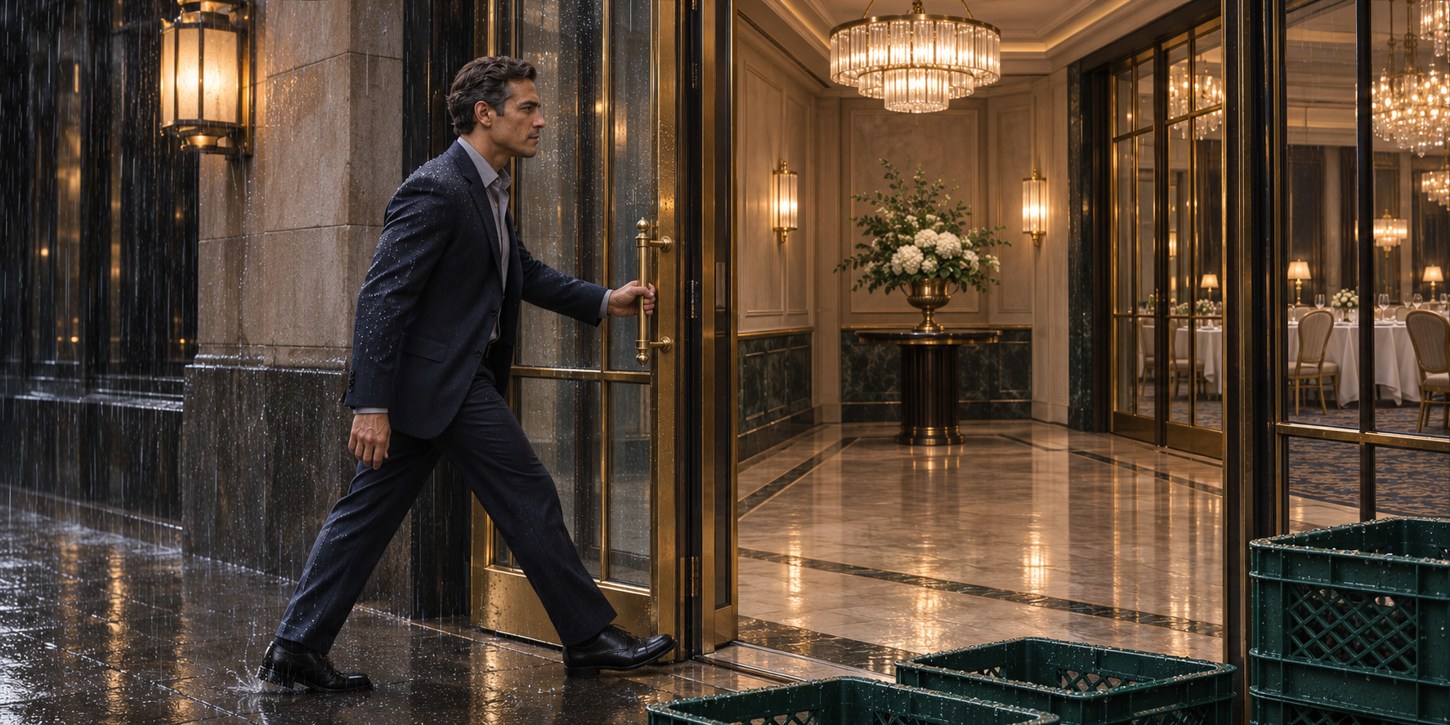
Nora glanced down the hall. The other door led to a stone passage between two wings of the building. The passage had an awning over part of it and a drain in the middle where rain collected faster than the drain could swallow it. There were green racks out there, piled neatly against the wall after an afternoon delivery. Somebody had turned the light on for the delivery driver and left it burning.
"Am I going home?"
Lydia stared at her long enough for the question to sound like an embarrassment. "You want to make a mess? There’s a place for trash. Out there."
It was the ease with which she said it that Nora would remember later. Lydia had one glass in each hand and a folded napkin over her arm. She looked like a person who could walk back out into the room and offer a lovely evening to somebody else within the same breath.
Nora opened the door and went through. She stood under the awning at first. From there she could have followed the shallow gutter a little way and gone around the side of the building to the parking lot. Her phone was still in her bag in the locker behind the curtain. There was a key to the staff door clipped to her bag. She had left her car keys in it as well. She tried the service door once and felt it catch. Then she sat near the crates, brought both knees up, and waited for somebody to open it.
The water found her through the gap below the awning where the wind came around the corner. Her shirt got wet along the shoulders and finally across both arms. She could have stood somewhere else, but she was beginning to feel the shock of the last few minutes in her legs, as though she’d missed a step on a staircase and still hadn’t landed. There was a place the crates had kept dry, just big enough for the heels of both shoes. She put her heels there and concentrated on how to get through the rest of the evening without calling anybody and having to tell them what had happened.
The man by the crates
Adrian Mercer arrived by the passage because he had given his place in the main lot to a guest with a cane. He had spent eight years as one of two partners at the Bellwether. He did the work that tended to leave his name on a printed program and took extra care to learn the work that didn’t, like cleaning a floor drain after somebody dropped a handful of labels into it. He’d bought his suit at a place where the clerk wrote notes about customers on envelopes. This time the clerk had told him to get the jacket cleaned before the wedding season. The rain was already starting to darken one shoulder.
He could see the woman at first only by the whiteness of her sleeves. Her dark hair was gathered high enough to show the back of her neck below the wet knot. There was a piece of white paper trapped against a crate by the rain. He mistook it for a napkin until he saw a strip of printed numbers. When the woman didn’t get up, he lowered himself so he could see her face. His shoes gave a wet squeak against the stone.
"Who left you out here?"
She watched him for a moment, trying to work out whether his concern might be something she would be required to repay. There was a mark on the wall behind his shoulder from where stacked racks had struck it a hundred times. She used the mark to steady her eyes while she spoke.
"The manager." She drew one short breath. "I broke a wineglass."
He kept looking at her. The first part of her story ought to have been enough to explain the second, yet he could see her struggling to get to what she had really been asked. He waited for it.
"She said I belong in the trash."
Adrian’s eyes went to the crates and came back to her face. He didn’t like the immediate sweep of things his mind tried to do, the inventory of reasons somebody might want to get back at Lydia or the arithmetic of how long a person had to sit outside before the person who sent her there would remember. A moment later he had a much simpler thought. Even if all of those questions mattered, the woman would still be sitting there in a soaked shirt.
"Trash?" he said. He let the rain run down his shoulder for another breath. "Not in my restaurant."
She looked up at him properly then. There were lines at the corners of his eyes that she hadn’t seen from farther away. He put a hand on her forearm for a moment. The weight of it was light enough to lift away from. Then he stood and took his hand back.
He didn’t tell her she’d be all right. She was still cold. He asked whether she wanted a dry jacket or a towel. She asked him to find her bag first. If he could find a towel on the way, that would help. He said he would bring both out himself if the bag was where she thought it was.
The brass door at the end of the passage opened into the banquet wing. Adrian put one hand on the handle and crossed the threshold. On the other side, the noise of the dinner came up around him. Two of the chandeliers had been dimmed for the speeches. The third remained at full brightness over the central aisle because a guest had asked for enough light to read her notes. Everybody could see him walking toward the tables with wet shoulders and no coat.
What Rosa saw
Lydia caught him halfway along the aisle. She had come out to help a guest find a pen. Adrian asked her to open the locker for Nora if it was locked and give him the bag inside. Lydia said she would take care of it as soon as dessert was plated. Her eyes went past him twice, looking for somebody to take his attention. He said he needed the bag immediately.
"She dropped a glass," Lydia said. "She couldn’t handle a full tray. I took her off the floor for her own good."
"You put her outside. Her shirt is soaked."
"She could have come back in whenever she liked."
"Can you open that door from outside without a key?"
Lydia looked in the direction of the door. The seating chart was still in her hand. Adrian could see her fold the page by squeezing it between her fingers. She asked who was supposed to manage the dinner if she had to explain every time an employee used the wrong exit. Her voice was still quiet. The two of them were far enough from the nearest table that the guests there would have had to stop talking to catch what was said.
Adrian wanted to ask in front of everybody. He wanted to see what Lydia would say about trash to a woman whose name was printed on a donor’s card, and what all the speeches about the importance of public space would sound like after that. Then he thought about Nora waiting for a towel. He asked Lydia for the keys to the locker. She took them from the pocket of her jacket and put them in his hand.
At the back station he found Nora’s bag on a hook inside the locker. It was open just far enough to reveal the teeth of a plastic comb and a birthday card in a pale blue envelope. He brought the bag, a clean kitchen towel, and the extra charcoal fleece he kept on the office peg. Nora stood to take them. She put the towel over her head first, like a hood, and for the first time since they’d met he saw her come close to smiling.
"Can I go home?" she asked.
"Yes. Do you want me to call somebody, or would you rather get yourself there?"
She took out her keys and told him she would sit in the car for a while until her hands warmed up. He said there was a chair in the office if she preferred to stay inside and no one else needed to come in. Nora thought about the office. Then she asked him which way got her to the parking lot. He showed her the way with his phone flashlight. They left by the passage where she had come out. This time she pushed the door the whole way open herself.
Adrian found Rosa in the banquet hall when he came back. She had found the small dusty broom nobody used because it barely reached the floor if you held the handle the way it was meant to be held. The broken glass was gone. She used the broom to sweep the edge of the carpet, in case a last piece was lying there under the fringe. The trolley stayed where the kitchen crew had pulled it off to the side. A scrap of tape clung to the front rail.
Rosa put the broom down and went to the trolley. "Look at this wheel."
She took the handle of the trolley with both hands and pulled gently. Three wheels rolled. The fourth turned just far enough to catch against the housing. When she reversed the motion, it stuck and the load shifted to the side. Adrian saw the mark where the caster had been dragging on the stone. The line looked like an old pencil mark.
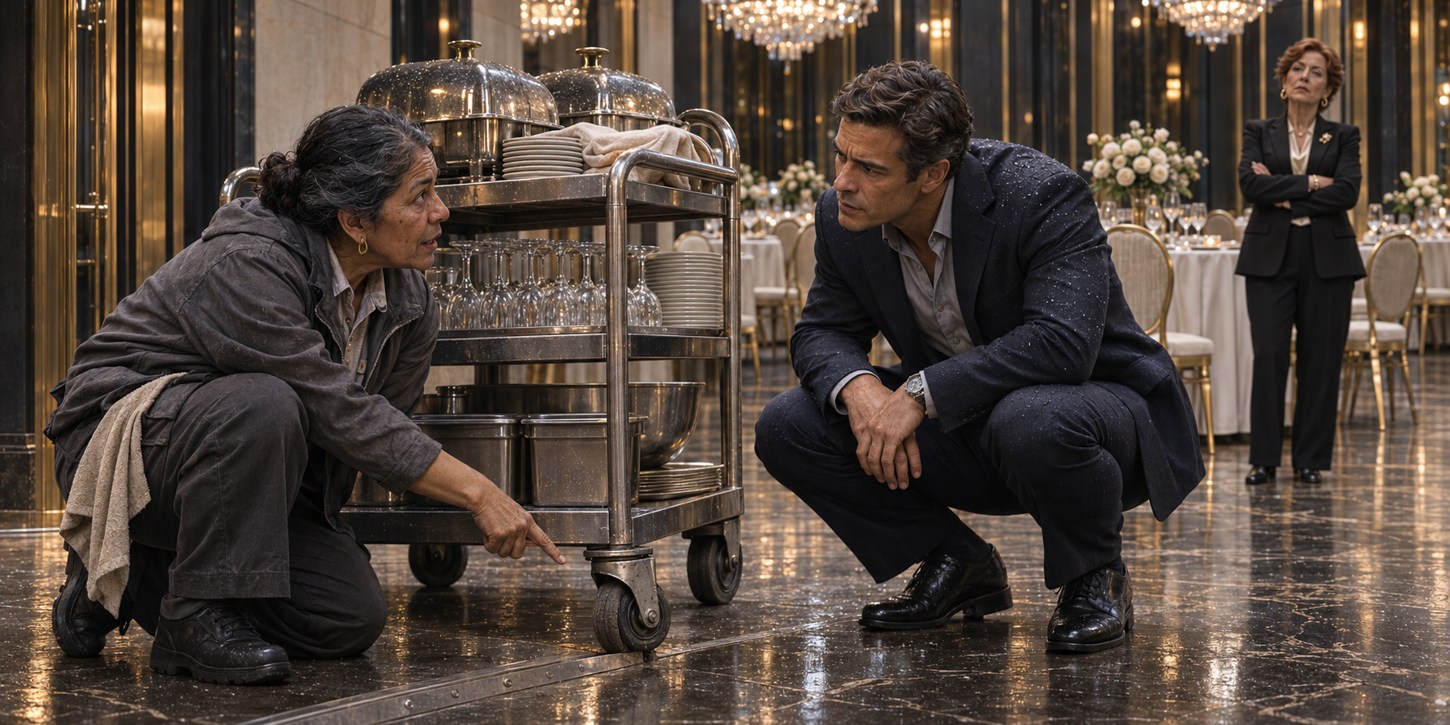
"I put in a repair request in August," Rosa said. "They wrote down the wrong number the first time. I asked them to change it the second time."
"Who saw it break?"
"A guest near the curtain saw the trolley hit the tray. I know because he picked up a chair to keep people off the glass. Lydia told me to move along before I finished explaining."
The woman in the black jacket at the back of the room was Lydia. She was looking at them from the door of the kitchen, and she had not yet seen Adrian notice her. When he turned his head, she turned hers. Rosa let the trolley come to rest. She had worked in banquet halls long enough to know the danger of being the only person who remembered an instruction. She asked if Adrian would write down what she had said while she was standing there.
He took a little pad off the service station, recorded the time and wrote down what she’d shown him. He read his account back to her. Rosa asked him to change the part where he had written that Lydia had walked off. She said Lydia had stood through most of the explanation and waited until Rosa said the wheel. Then she had told her that there were people waiting for plates. Rosa had given too many careful accounts over the years to leave a loose verb in someone else’s hands.
Adrian changed it and asked for the exact location of the service requests. Rosa told him the first request had been on a white pad and the second request had been in a shared inbox. He thanked her. He put a sign on the trolley and asked the lead waiter to have it moved aside once it was empty. Then he spoke with the guest who had lifted the chair, privately near the coatroom. The man told him the server’s first instinct had been to warn him about the broken pieces. He remembered it because he’d had new shoes on and had been thinking about them at the time.
The empty line
It was after midnight when Adrian could read the incident log. The office walls were made of unpainted cinderblock on the side where an old fireplace had once been walled up. Papers pulled cool air around their edges if you set them down too close to the vent. The original form for the night had space for a breakage, a name, and a charge to an event. In the space for the name, Lydia had written casual staff. In the space for the charge, she had put a single line.
Adrian printed the message Rosa had sent about the wheel. There was a reply from Lydia asking which service number corresponded to the trolley. Rosa had answered the next morning. In the months between the request and the dinner, the shared inbox contained no further reply about the wheel. There was a stack of other requests. Adrian understood that the one about the wheel would have been easy to miss. He had come to recognize what people meant when they said that from this particular chair, in a room cooled by a vent that often blasted the papers off the desk.
Then he went looking for the incident reports that would show whether anybody had been sent outside before. Those could have been in a different folder or another notebook. He asked the night supervisor. The man said Lydia sometimes resolved staff problems verbally and another manager sometimes wrote a note in the schedule before removing a name. Nobody could remember which nights. There was little he could draw from that information except how inconsistently his managers had been expected to make decisions and tell people about them. He put the issue at the top of the page he was writing.
When he tried to call Nora, straight to voicemail, he changed his mind before leaving a message. He sent one that said he’d like to pay her for the full shift, that he would send an update the next afternoon, and that if she wanted to tell him more she could write it or come in, with somebody else if she preferred. He asked her to wait until morning to respond unless there was something she needed that night.
Nora read the message at home in a sweater that had once belonged to her sister. Her jeans and shirt were hanging in the shower. She had driven back from the restaurant with the heat running so high that the marks left by her wet sleeves had dried in the fleece, but her wrists still seemed to know when it had rained. Her sister asked if she had decided whether she was going back. Nora told her the question was a little early. She set an alarm at her regular time and lay down on the couch because it was where she best liked to hear the familiar noises of the building.
In the morning she wrote out what she remembered. She started with the glass, because it was the part she least wanted to write. She described exactly how she had held the tray and the fraction of time between hitting the trolley and the glass going over the edge. She wrote that she had gone outside because a person with the authority to send her home had ordered her there. When she got to the door, she drew a little empty square in the margin of the notebook. It took her a minute to realize it was a window the door did not actually have. She crossed the square out and wrote that once the door shut, she couldn’t see inside or tell whether anyone was coming.
She wasn’t sure whether to mention where she had hoped to stand after she went back in. The thought embarrassed her. Before the glass broke, Nora had been studying the dining room because she wanted to be someone who ran one of those rooms one day. She had watched a guest pull his own chair in from the wall so a stranger could fit near him, and she had watched Rosa quietly produce a linen napkin for someone who’d spilled water across her skirt. She liked the small work that made a room worth staying in. Outside, she had been imagining that if she could find one person willing to ask for a glass of water, she could carry it out and pick up exactly where she had left off.
When Adrian called that afternoon, she told him she wanted to come in. She wanted Lydia to hear what she remembered, if Lydia was willing. She asked to have Rosa there for the part Rosa had seen. She told him that if he expected her to decide whether to come back before she opened the door to the office, she would stay home. He said she could make that decision another day.
The meeting in daylight
The meeting took place two days later, with the door of the office propped open. Nora had chosen the chair nearest the opening. From there she could see a strip of the passage with a bucket of freshly cut flowers on it and whoever walked past could see her, too. She had written a list instead of bringing the notebook. Adrian’s business partner was there, and Rosa would come in when she was finished with a delivery. Lydia sat with her hands under the table.
Nora read the list. Talked about the curtain, the trolley, the glass and the dustpan. She read the actual words as best she could remember them. When she got to out there, she noticed that Lydia had put both of her hands on the table. Nora told them what she had been thinking about as the door left her reach. Her first thought had been how much trouble it would be if she knocked loudly and somebody inside the banquet heard it. She hadn’t wanted to make anybody’s night worse. She had stayed outside because she had expected Lydia to realize that she had been carried away for a moment. In the end, Nora watched the marks her cuff made on her sleeve and tried to decide which coworker would come outside first.
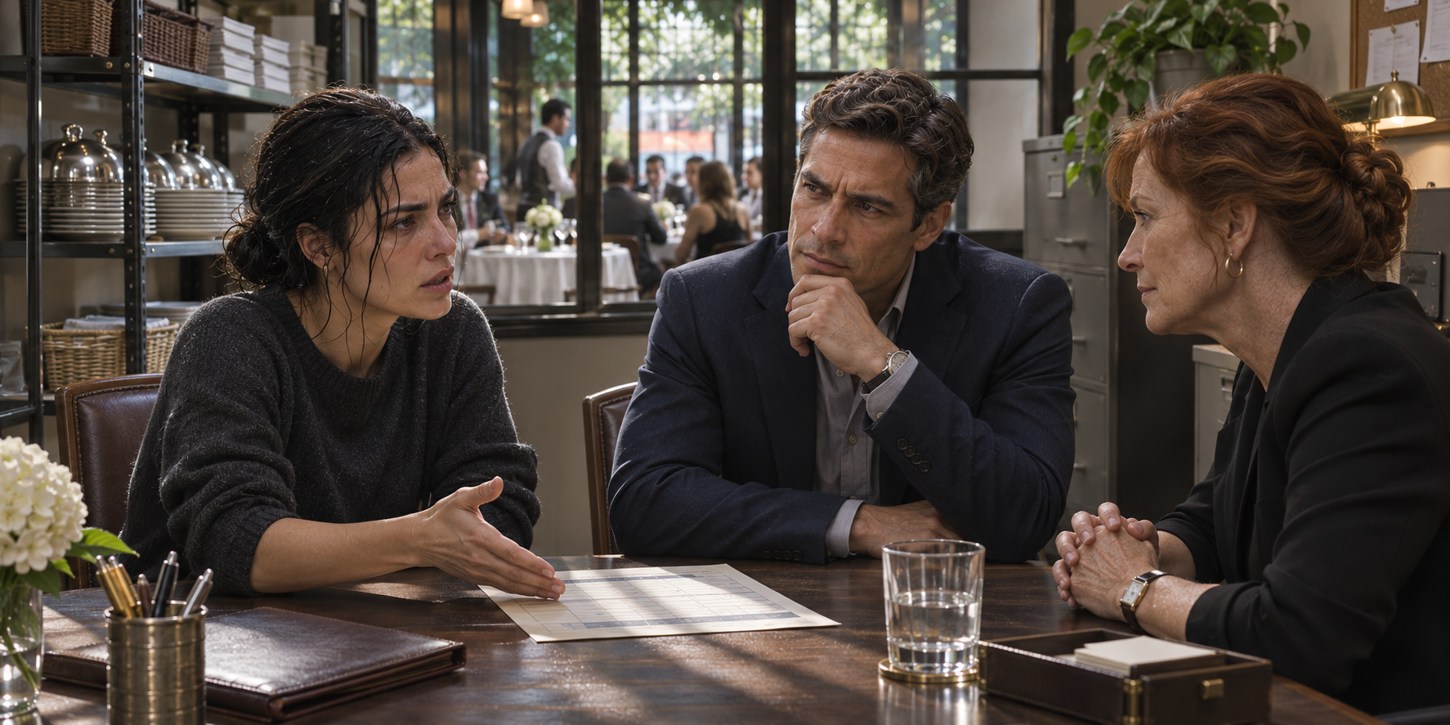
"I was angry," Lydia said when Nora finished. "I thought if I let you return to the floor, I’d have to explain the broken glass to people who’d barely noticed. I used an awful word. I don’t remember saying you belong in it. I remember telling you there was a place for it."
"I remember what I heard," Nora said.
Lydia pressed the pads of her fingers together. She had written down that the dinner had been two courses behind by the time the glass broke. When she looked up, nobody was asking how far behind dinner had been. She told Nora that she had pointed through a door that locked from outside and never gone to see if Nora had somewhere to go after she closed it. She said she was sorry about what she’d said and for leaving her there. Nora let the apology finish. She wondered whether there’d be a request for an answer. There was a much longer silence than she could have tolerated the night of the dinner.
"I heard you," she said at last. "I need some time to think about what it means."
Rosa arrived in her work jacket, gave her account of the trolley, and stayed to talk about how the cabinet for repair slips had become the cabinet everyone used for pens. The partner asked what Rosa would do with the cabinet. She said the issue was that people used the trolley every night. If it was unsafe on Tuesday, there needed to be a way to put it aside on Tuesday. They shouldn’t have to wait for a particular person to find a particular piece of paper. She suggested a way for the shift lead to flag the equipment visibly and assign a replacement before people turned up for dinner. Adrian wrote it down. She watched him write it to the end, then asked if he would send her the name of the person responsible for buying the replacement caster.
The partner told them that Lydia had been taken off shift management while the accounts were being reviewed. She would be paid for her work already done and could give her full account in writing. The owners would contact the staff from the shifts they could identify and give them a direct way to discuss similar incidents, whether they were still employed or not. She asked Nora to think about whether she wanted a copy of the notes. Nora said she wanted one, with her name written out in full.
As they were getting up, Lydia asked if she might say one more thing. Nora looked toward the bucket of flowers outside the office. There were still deliveries to get through and the person who had left the flowers there had been careful to tuck the bucket out of anybody’s way.
"Another day," Nora said. "I’ve said what I came here to say."
Tuesday
The restaurant paid Nora for the shift. She received the corrected notes that afternoon and the first written account of what had happened to the trolley a few days later. In the time it took the restaurant to finish looking into past incidents, Lydia resigned. Adrian told Nora that much when she asked. He offered no version of what Lydia had told him privately, and he didn’t use the update to raise the subject of a shift. Nora kept going to the bookstore. She shelved paperbacks and wrote the price of a used field guide on a label small enough to fit over the other store’s label. Weeks passed before she could see a neat new row of wineglasses somewhere without thinking of the ones on the tray.
A month later she called Rosa to see if the caster had been replaced. Rosa said the old trolley now rolled straight with a load of plates, though she would never like seeing it in that doorway. They had found a place past the curtain where loaded trolleys could wait out of the path of a server. She and the lead waiter had spent a floor-closing hour figuring out how different loads would fit there. Nora asked whether the layout worked on a full night. Rosa said so far it did. If Nora wanted to see for herself, Rosa could use a hand showing it to a new hire on Tuesday.
Nora went in early to meet her. The canopy had been repaired and the passage smelled faintly of wet leaves, even though it hadn’t rained for two days. They had put a plain bench against the wall, far enough from the crates that two people could sit without someone taking it for a delivery area. The glass racks had a dry shelf to themselves. Adrian came to meet her from the reception room in rolled shirtsleeves. He had a folder in his hand containing a quick written outline of the training shift. He showed her where the restaurant now kept the names of staff representatives and a list of the people she could go to during the event. She noticed that the first name on the training page was Rosa’s.
They talked about what Nora would like to do that evening. She could show the new person how to get from the floor to the service passage when the room was busy. She could stay for the rest of the training if she enjoyed it. Adrian asked her what she was looking for in a restaurant job, and she said she’d like to know how to run a section, partly so she could help somebody else get comfortable doing it. He showed her the page where Rosa had written the stages in the work and asked if she thought the order made sense. They went through it twice. Nora changed a line that said a new person should first come in through the staff entrance. She put in a line before it about knowing how to get back in.
They crossed the banquet hall together, and Adrian told a new employee named June that Nora would take her through the short practice after Rosa finished showing her the back of the house. Then he left them to talk. June wore an apron that still had creases from its packaging. She had a job at a pharmacy three mornings a week and was going to start as a banquet server on weekends. She carried a small pad, and every time there was an instruction she feared she’d forget she wrote down the first word of it as if she could fill in the rest by looking at that later. Rosa asked her why she was saving paper. June said she had only brought three sheets. Rosa tore a sheet from her own pad, gave it to her, and said they would see if they could get her through a lap without using the whole thing.
Nora walked June around the curtain. At the trolley she asked her to stop. The two of them stood side by side and watched Rosa reverse the empty trolley to show them how the space worked. Nora felt a tightening in her chest when she heard the click where it crossed the tile seam. She had expected the sound to be nothing, or she had expected it to take her all the way back. Instead she could see that Rosa had pushed it into a place where it belonged, against the wall with its brake on, a good distance from June’s elbow.
They went to table six. The old photographs were gone. A guest had left a glove between the table and the wall, and Nora picked it up and took it to the service stand to go in the box for things people had forgotten. When she came back, June had folded a napkin twice and was looking at it exactly the way Nora had looked at hers the night of the dinner. Nora set the glasses down at both places. The first was thick and sturdy. The second had the slender stem, the one that caught the light when you lifted it.
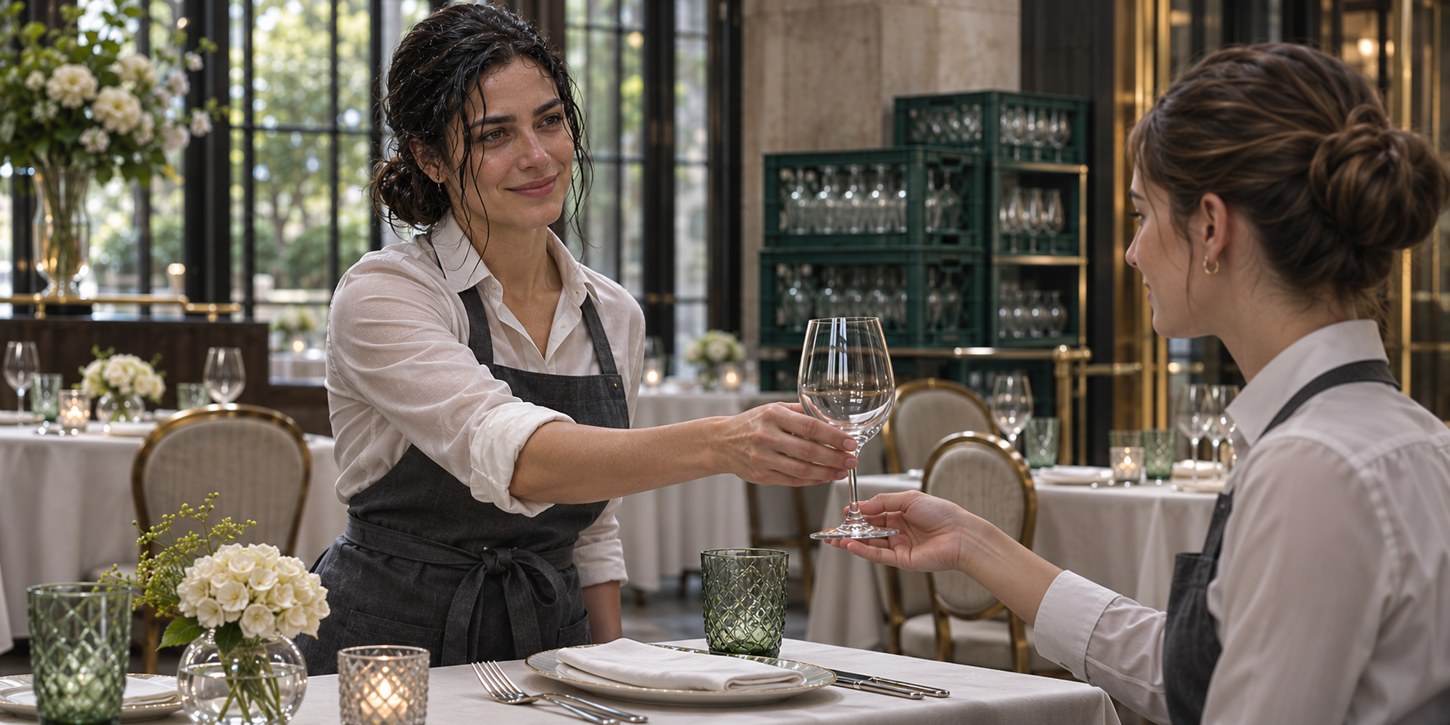
"Can I try carrying that one?" June asked.
Nora put it in her hand. She told her to notice how much pressure she was using, loosen her grip a little, and try another step. June took her time. At the setting closest to the aisle, she lowered the glass, heard the foot make a small sound on the table, and asked if she could do it again. Nora felt for the edge of the chair until she could pull it back just far enough to give June more room. Then she stood quietly next to her while she tried.
This fictional adaptation develops an original ending beyond the events shown in the short video.