An illustrated fictional adaptation, with an original continuation and ending.
1. A Room Full of Voices
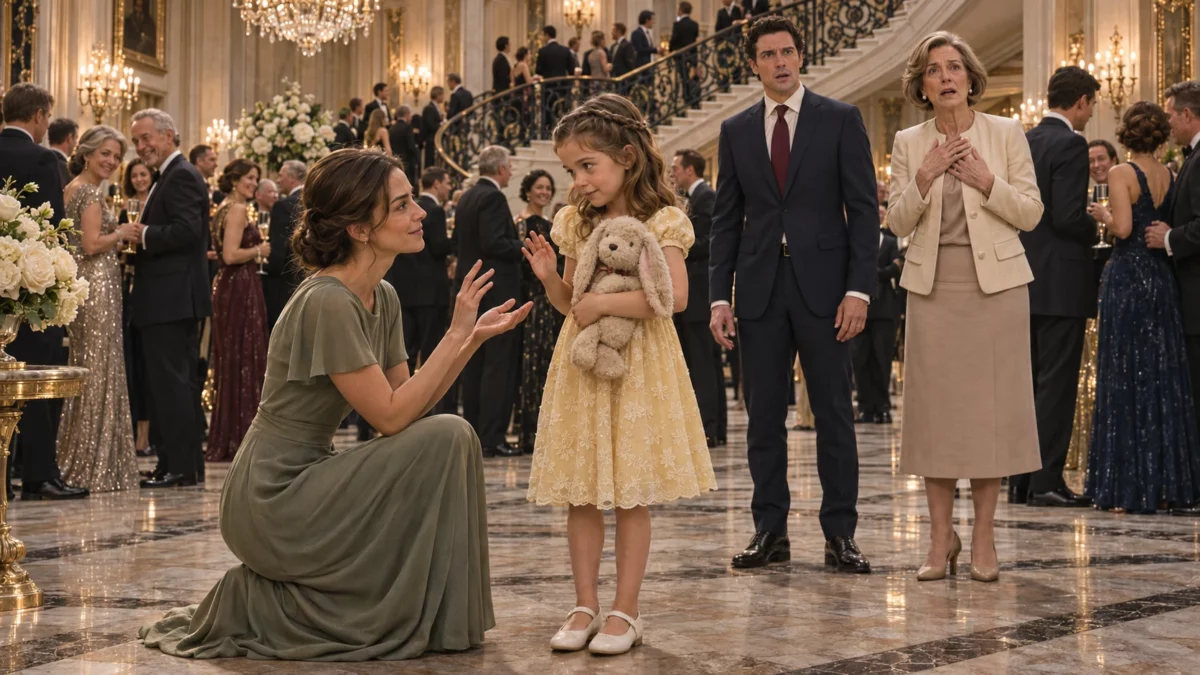
The chandeliers made the marble floor look like shallow water. Light trembled beneath polished shoes, climbed the white flower arrangements, and caught on the gold rim of every glass. All around the great staircase, guests greeted one another with the bright confidence of people who knew exactly what to say.
Lily stood near a column and held her rabbit against her chest.
Its ears had once been cream. Now they were the color of weak tea, darkened where her fingers had worried the fabric. One embroidered eye sat slightly lower than the other. The rabbit had survived hospital waiting rooms, sleepless nights, and journeys during which adults spoke over Lily's head about what might help her.
Tonight it wore a ribbon that matched her pale yellow dress.
Her father, Thomas, had tied it badly. She had untied it when he looked away and made a smaller bow herself. He had noticed the neat result and almost said something. Then someone had called his name, and the moment had passed.
Beside him, Margaret watched her granddaughter with the alertness she brought to everything she could not fix. She had selected a soft dress, checked the seams, and put a familiar snack in her handbag. She had also explained to three different guests that Lily might not answer them.
Each explanation had made Lily press the rabbit closer.
The reception was supposed to raise money for a family support center. Thomas had promised that they would stay only briefly. He wanted to honor a commitment, thank the organizers, and leave before the noise became too much. His daughter had chosen to come after he showed her a photograph of the staircase and offered an equally acceptable evening at home.
Now he wished he had brought a quieter room with him.
A woman in a silver dress bent toward Lily. “What a beautiful rabbit. Does he have a name?”
Thomas felt the familiar urgency rise inside him. He could leave the question hanging and risk Lily feeling exposed, or he could answer and protect her from the silence. He had made that choice so often that he no longer recognized it as a choice.
“She calls him Button,” he said.
Lily looked down.
The woman smiled kindly and moved on. Thomas rubbed the back of his neck. He could not have explained why such a small exchange left him feeling as though he had closed a door.
Across the hall, Nora set a forgotten program on a side table. She was there with a friend who helped organize the event. Her sage green dress was simpler than most of the gowns around her, and she had spent the first half hour looking for somewhere to stand that did not feel like a stage.
She noticed Lily because the little girl was looking at everyone's hands.
Not the jewelry. Not the glasses. The hands themselves: pointing, waving, reaching, interrupting. Nora followed that watchful gaze and saw a small hand lift from the rabbit's fur, hesitate, then disappear again.
She did not know the child's story. She did not know the number of appointments or the long year behind the adults' strained expressions.
She knew only that someone had tried to begin.
2. Before the Question

Nora approached slowly enough for Lily to see her coming. She stopped beyond arm's reach and glanced at Thomas before lowering herself to the child's eye level.
“Is it all right if I sit here for a moment?” she asked.
Thomas nodded. It was such an ordinary question that he did not immediately understand its importance. Nora had asked about her own presence. She had not asked Lily to perform a greeting, demonstrate progress, or prove that tonight was different.
Her dress pooled carefully beside her knees. She left a clear space between herself and the little girl. A waiter passed behind them with a tray of glasses, and Nora waited until he had gone before trying to catch Lily's gaze.
She held her hands where Lily could see them.
There was no grand gesture. Nora touched her chest, opened one palm, and gave a small, questioning tilt of her head. It was an invitation made from ordinary movement, not a claim that she knew a formal language Lily used.
Lily watched her fingers.
Nora did not fill the pause. The orchestra near the far doors changed pieces. Somewhere a woman laughed with her whole body. Behind Nora, Thomas shifted his weight, already preparing an explanation.
“You can talk to me,” Nora said gently. “I'm listening.”
Then she waited as though listening included everything that might happen next.
Lily's mouth tightened. Her gaze slipped toward her father, then returned to Nora. She raised two fingers, lowered one, and touched the rabbit's ear. Nora watched the movement without pretending to understand more than she did.
“I see your hand,” she said quietly. “You can show me again if you want.”
Margaret pressed a hand against the front of her jacket. Usually, by this point, someone was repeating a question in a louder voice. Usually Thomas was explaining, and Margaret was trying to soften his explanation. Usually Lily's shoulders were drawing inward.
Tonight the little girl's shoulders stayed where they were.
Lily lifted her hand again. Nora mirrored only the simple opening of her fingers, then paused. She let Lily decide whether to continue. The exchange had the tentative rhythm of two people finding a path across unfamiliar ground.
Thomas could see that nothing miraculous had happened. There was a child, a stranger, a rabbit, and a few quiet movements.
Yet he could not remember the last time his daughter had kept looking at someone for this long.
He took a step forward, then stopped when Lily's eyes flicked toward his shoes.
Nora noticed that, too. She shifted slightly so Lily did not have to choose between looking at her father and looking at her.
“There's no hurry,” she said.
The words were directed to Lily. Thomas felt them land somewhere inside his own chest.
3. The Smallest Sound

The rabbit slipped a little under Lily's arm. She caught it against her dress, and Nora moved her hands back to make more room. That small retreat seemed to matter. Lily no longer had to protect the toy from an approaching adult.
She looked at Nora's open palm.
Then she brought her free hand forward.
Their fingers did not touch. Nora kept the space between them and followed the child's movement with her eyes. Around them, conversations continued, but several nearby guests had begun to notice Thomas standing unnaturally still.
Lily drew a breath that seemed too large for her chest.
“Nobody else ever understood.”
Her voice was so small that Thomas first thought the words had come from somewhere behind him. They were clear enough to recognize and soft enough to disappear beneath a single clink of glass.
He put a hand over his mouth.
Margaret's face changed all at once. Surprise opened it, then hope, then a kind of fear. She reached toward Thomas's sleeve without looking at him.
Nora did not gasp. She did not turn to the adults and announce what had happened. Her eyes stayed with Lily.
“Thank you for telling me,” she said.
Lily's gaze wavered. The words had taken something from her, and she seemed uncertain what the room would now expect in return. Her hand moved back toward the rabbit.
Thomas wanted to say her name. He wanted to kneel, gather her up, ask her to say anything again. Every sound he had missed over the past year seemed to crowd into his throat at once.
Margaret spoke first, barely above a whisper.
“She hasn't spoken or signed to anyone in a whole year.”
It was how the year felt to her: a long absence of the communication they remembered. Yet Thomas knew Lily had never stopped communicating altogether. She chose clothes, moved away from noise, pointed at books, and put his hand on things she needed him to notice. They had become so focused on what had disappeared that sometimes they overlooked what remained.
Nora glanced up, and the compassion in her expression did not invite celebration. It asked for gentleness.
“Then let's make this easy for her,” she said.
A nearby guest leaned sideways for a better view. Someone murmured a question. Thomas saw Lily notice the new faces turning toward her, and he recognized the beginning of retreat.
Who was this woman? And how had she reached a moment that so many careful appointments had not produced in front of him?
For a second he wanted a secret explanation. A special method. A missing piece someone could finally hand him.
Nora was already looking away from the gathering audience and toward a quieter doorway.
The next thing she asked him was not about the words.
It was whether Lily would like somewhere less crowded.
4. The Crowd Steps Back
Thomas turned before the nearest guest could ask Lily another question.
“Please give us a little space,” he said.
He did not raise his voice. He did not explain his daughter's history. He moved his own body between the curious faces and the small girl in the yellow dress, and for once he let his answer be enough.
The guest apologized and stepped back. Thomas thanked her. Then he crouched several feet from Lily, keeping his hands on his own knees.
“Would you like the little room by the garden?” he asked. “Or would you rather go home?”
He made himself stop there.
Lily watched his face. Usually there was another sentence after a question, something meant to help her decide or rescue her from deciding. Thomas felt the second sentence gathering and swallowed it.
She pointed toward the garden doors.
“All right,” he said.
Margaret went ahead to ask the event staff about a quiet space. She had spent a year becoming skilled at arranging things around Lily. Tonight she tried to arrange something without arranging Lily herself.
Nora remained on her knees until the little girl took a step. Only then did she stand, slowly smoothing the fabric of her dress. She did not offer her hand. Lily had not asked for it.
They crossed the hall together, Thomas on the side nearest the crowd. Nora walked a little behind Lily so that the child could set the pace. The rabbit's ears bounced against her elbow.
At the doorway, a man Thomas knew from business touched his arm.
“Everything all right?”
Thomas looked at his daughter before answering.
“We're taking a quiet minute.”
It was the first time that evening he had described what they were doing instead of describing what was wrong.
The side room contained a low sofa, two chairs, a table with a water pitcher, and tall windows facing an unlit garden. The music reached it as a distant pulse rather than an instruction to stay cheerful.
Lily went to the window. She stood close enough to see her reflection and held the rabbit beneath her chin.
Margaret pulled a chair out, then remembered herself and left it empty. Nora waited near the door.
Thomas wanted to ask a hundred questions. He could feel them moving behind his teeth. How had Nora known to approach? What did the hand movements mean? Had she worked with children? Could she come tomorrow? Could they arrange a meeting, an appointment, a plan?
Instead he looked at Lily's reflection.
“Would you like Nora to stay?” he asked.
Lily turned. Her eyes rested on Nora, then on the empty chair. She gave one small nod.
Nora sat.
No one asked Lily to speak again.
5. What Nora Had Not Done
For a while, the only sound in the room was water entering a glass.
Thomas put it within Lily's reach and moved away. Margaret sat near the wall, her handbag still closed over the snack she had packed. Nora rested her hands loosely in her lap.
“I'm sorry,” Thomas said at last. “I don't even know your name.”
“Nora.”
He introduced himself and Margaret. When he reached Lily's name, he paused and glanced toward her. She was tracing the window frame with one fingertip.
“And this is Lily,” he said softly.
Nora gave the child a small nod, as though the introduction was a courtesy rather than a test.
Thomas sat on the edge of the other chair. “Do you work at the center?”
“No. My friend helps organize the reception. I came with her.”
“But you knew what to do.”
Nora considered the sentence. “I knew I could wait.”
Margaret let out a breath that was almost a laugh and almost a sob.
Thomas looked down at his hands. He had waited in corridors, waited for reports, waited beside his daughter's bed. He had waited through entire seasons. The suggestion that waiting might be something he had not done felt unfair for an instant.
Nora seemed to understand the flicker in his face.
“I don't mean you haven't been patient,” she said. “I mean that in those few seconds, I didn't need her to give me anything.”
Lily turned from the window. She looked at Nora with the serious attention children give adults who are speaking close to the truth.
Nora continued more carefully. “I don't know why she spoke tonight. I wouldn't want to invent a reason. I only noticed that she was trying to show something with her hand, and people were moving on before she finished.”
Margaret opened her handbag and closed it again.
“I do that,” she said. “I think I'm helping.”
“So do I,” Thomas said.
Neither spoke for a moment.
Nora did not offer a judgment. She was not there to examine their year or reduce it to a mistake. She could see the tiredness beneath Thomas's formal clothes and the love in Margaret's relentless attention.
“You can love someone very much and still find it hard not to hurry them,” she said.
Lily came away from the window. She took the water, drank, and placed the glass carefully back on the table. Then she chose the end of the sofa nearest Nora's chair.
Thomas watched without naming the choice aloud.
For the first time that evening, he was beginning to understand that noticing something did not always require announcing it.
6. The Year Between
Later, Thomas would remember the quiet room more clearly than the moment in the hall. The great surprise had opened something. The quiet room showed him what to do with the opening.
“Her mother died last spring,” he said.
The words changed the room without making it colder. Nora glanced toward Lily, giving Thomas time to decide how much belonged in front of her.
“She knows,” he said. Then he corrected himself. “Of course she knows. I mean, we don't hide the word.”
Margaret looked at the rabbit.
“Her mother repaired his ear,” she said. “The little crooked seam.”
Lily rubbed the seam with her thumb.
Thomas had told versions of the year's story many times. Tonight he kept it smaller. He spoke about breakfasts after the funeral, about a voice that became harder to hear and then absent, about conversations with professionals who had urged them to reduce pressure and make room for different ways of responding.
“They haven't done nothing,” he said, as though defending people who were not there. “They've helped her sleep. Helped us understand things. I just kept looking for the part where she talked again.”
Nora nodded. “It can be hard to see work that doesn't arrive as the thing you miss most.”
Thomas looked up. “You sound as if you know.”
“A little. From my own life.”
She did not rush into her history. Lily had settled the rabbit across her knees and was arranging its ears so they hung evenly.
“When I was younger, I went through a time when speaking felt much harder than people thought it should,” Nora said. “The reasons weren't the same as Lily's. I wouldn't assume that. But I remember adults asking a question, then another, then explaining what I probably meant.”
“What helped?” Margaret asked.
“Different things, over time. People who stayed kind on quiet days. Help from someone qualified. Being allowed to write or point without everyone treating it as second best.”
Thomas leaned back. The answer offered no dramatic rescue, and because of that he trusted it more.
Nora looked at him. “Tonight doesn't erase the rest of the year. And a quiet morning tomorrow wouldn't erase tonight.”
The sentence caught him where hope was already turning into fear. He had been imagining breakfast: his daughter looking up, answering him, saying good morning. He had also been imagining what it would do to him if she did not.
On the sofa, Lily lifted the rabbit and put its face toward Nora.
Nora gave it the same attentive nod she had given Lily.
“Hello, Button,” she said.
Lily's mouth made the smallest movement toward a smile.
7. A Request Without a Word
Margaret finally took the snack from her handbag. She held up the familiar packet where Lily could see it, then placed it beside the water.
Lily reached for it at once.
“I should have offered that sooner,” Margaret murmured.
Thomas almost told her not to blame herself. Then he realized that she was not asking him to rescue her from a feeling. She was simply noticing something. He let the observation stay.
Lily opened the packet and divided two small crackers on the table. She took one and pushed the other toward Nora.
“Thank you,” Nora said, accepting it.
No one described the offer as progress. No one reached for a phone to preserve it.
The room grew ordinary enough for Lily to look around it. There was a stack of blank event cards beside a bowl of unused ribbons. Nora followed her gaze.
“Would you like paper?”
Lily nodded.
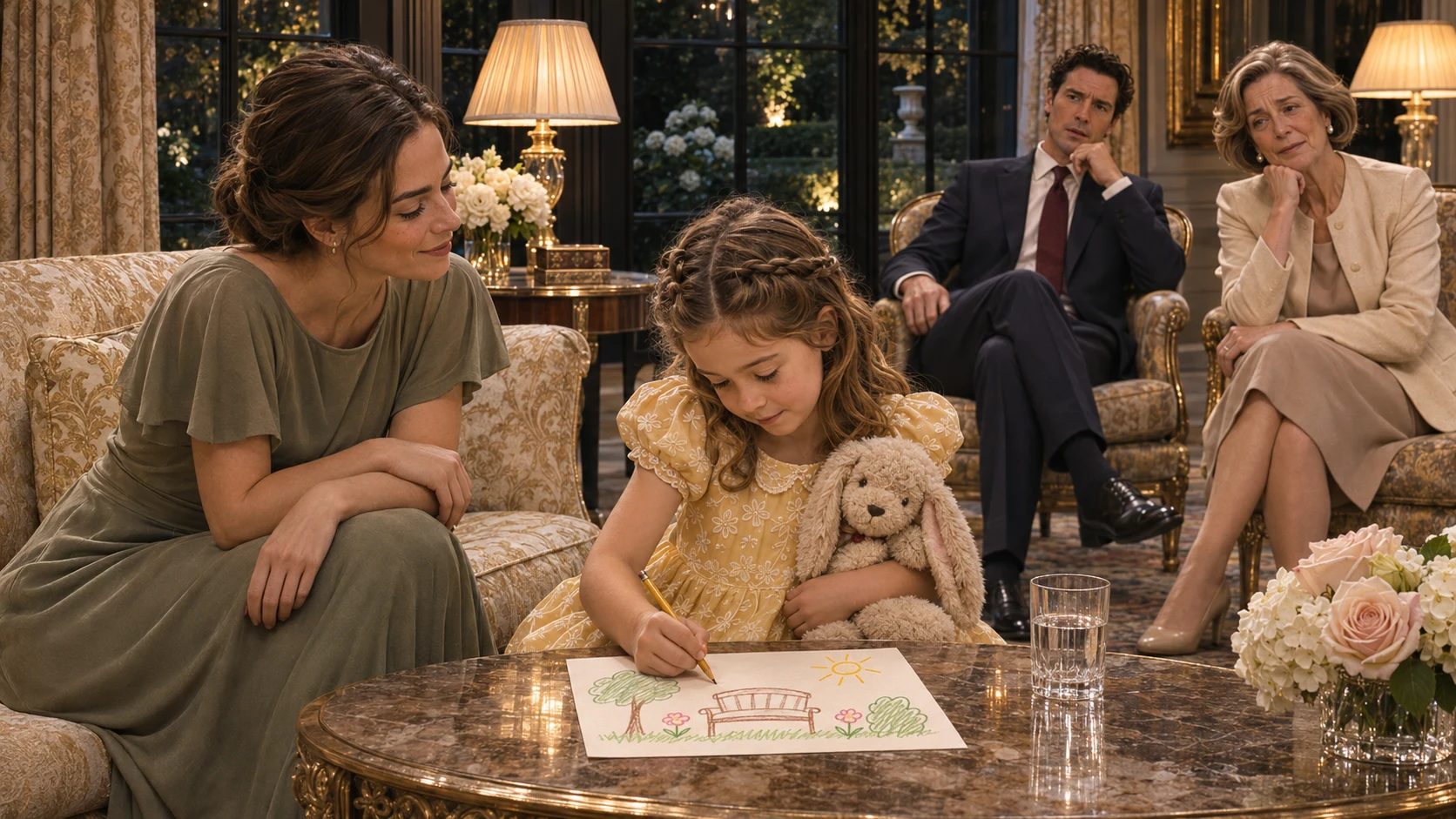
Thomas found a pencil in his jacket. He put it on the table rather than into Lily's hand. She picked it up, then pulled a card toward herself.
Her first drawing was a rectangle with two long lines beneath it. She added a smaller rectangle inside and three dots along one side. Margaret leaned forward, puzzled.
Lily looked up before either adult could guess.
Nora waited.
The little girl drew a curved line beside the rectangle and shaded it with the side of the pencil. Then she pointed at the window, at Thomas, and at the picture.
Thomas recognized the side door of their house. The shaded shape was the bench beneath the kitchen window, where Lily's mother had kept a pot of rosemary.
“The garden bench?” he asked.
Lily nodded. She added a small round shape on the seat and two long ears.
“You want Button to sit there?”
She frowned and crossed one line through the rabbit. Thomas stopped before trying another answer.
Lily drew three simple figures beside the bench: one tall, one short, one with a broad skirt. She pointed at Thomas, then herself, then Margaret.
“You want us to sit there,” he said.
Her shoulders dropped with relief.
“Tomorrow?”
She nodded again.
Thomas felt the familiar urge to make the request larger. They could spend the whole afternoon there. They could invite someone, buy new flowers, make it a special family day.
He looked at the small drawing and answered the request she had actually made.
“Yes. We can sit there tomorrow.”
Lily placed the card inside the rabbit's folded arms. Then she leaned against the sofa cushion, tired in a way that no longer looked quite so lonely.
8. The Conversation Outside
Thomas asked Margaret to stay with Lily while he and Nora stepped just beyond the doorway. He kept the door open. Lily could see them if she turned her head.
The noise of the reception returned immediately: shoes on marble, music, an announcement about the evening's donations. Thomas was surprised that the hall could have continued unchanged while something inside him had shifted so completely.
“I want to thank you properly,” he said.
Nora glanced toward the room. “You already have.”
“I mean, if there's something I can do.”
He stopped. He knew how he sounded. The habits that served him in business had arrived at the doorway with him: name the value, find the exchange, secure what mattered before it disappeared.
“I'm sorry. That came out badly.”
“You don't owe me anything.”
Thomas looked past her at the staircase. “I'm frightened she'll think we weren't listening before.”
“You can show her you're listening now.”
“And if she doesn't speak again?”
Nora did not look away from the question.
“Then she still deserves the same answer.”
For a long moment he could not speak. The thought was simple enough that he felt ashamed of how much it changed. He had believed his love was unconditional. He still believed that. But he could see how often his relief had arrived only when Lily did something he had been hoping for.
He could love her without conditions and still have made his hope feel like a demand.
Inside the room, Margaret was sitting on the floor in her cream skirt. Lily had given her a ribbon and was demonstrating how to make a bow around the rabbit's wrist. Margaret's first attempt was clumsy. Lily shook her head, undid it, and began again.
Thomas smiled through the sudden sting in his eyes.
“My mother hates sitting on floors,” he said.
Nora looked through the doorway. “She seems to be managing.”
An event coordinator approached to check whether they needed anything. Thomas thanked her for the room and asked that no announcement be made about what had happened in the hall.
“Of course,” she said. “Would you like us to keep people away?”
“Just let her have a quiet exit.”
Nora's friend appeared near the staircase and waited until Nora noticed her. It was nearly time for them to leave.
Thomas felt a fresh urgency. “Could we keep in touch?”
“If Lily would like that,” Nora said. “And if you understand I'm a friend, not a replacement for the people helping your family.”
Thomas nodded.
This time he understood the boundary as part of the kindness.
9. The Morning He Feared
Lily did not speak at breakfast.
Thomas had promised himself he would be ready, but readiness did not stop the small ache when she entered the kitchen and went quietly to her chair. Button sat beneath one arm. The ribbon Margaret had tied the night before was loose but still attached.
He wanted to ask how she felt. He wanted to mention Nora. He wanted to say that she had been wonderful, brave, amazing.
Instead he put toast on the table.
“Good morning, Lily.”
She looked at him and raised her hand a little.
“Good morning,” he said again, answering the greeting he had received rather than waiting for a different one.
Margaret arrived carrying a bag of oranges and the expression of someone trying very hard to behave normally. Thomas met her at the door before she reached the kitchen.
“Quiet morning,” he said.
She absorbed the news. He saw disappointment cross her face and recognized his own. Then she nodded.
“All right.”
She went in and asked Lily whether she wanted an orange. Lily nodded, then pointed at the knife drawer and held up two fingers.
“Two pieces to start?” Margaret asked.
Lily shook her head and spread her fingers farther apart.
Margaret paused. “Cut in half?”
A nod.
“Thank you. I understand.”
Thomas turned toward the sink so that neither of them had to watch his face change.
After breakfast, Lily fetched the drawing from the rabbit's arms and put it beside his plate. He checked the time, then reached for his phone to postpone a call.
He almost explained the sacrifice he was making. The impulse embarrassed him as soon as he recognized it. His daughter had asked him to sit on a bench. She did not need to carry the weight of everything he rearranged to do it.
“Ready when you are,” he said.
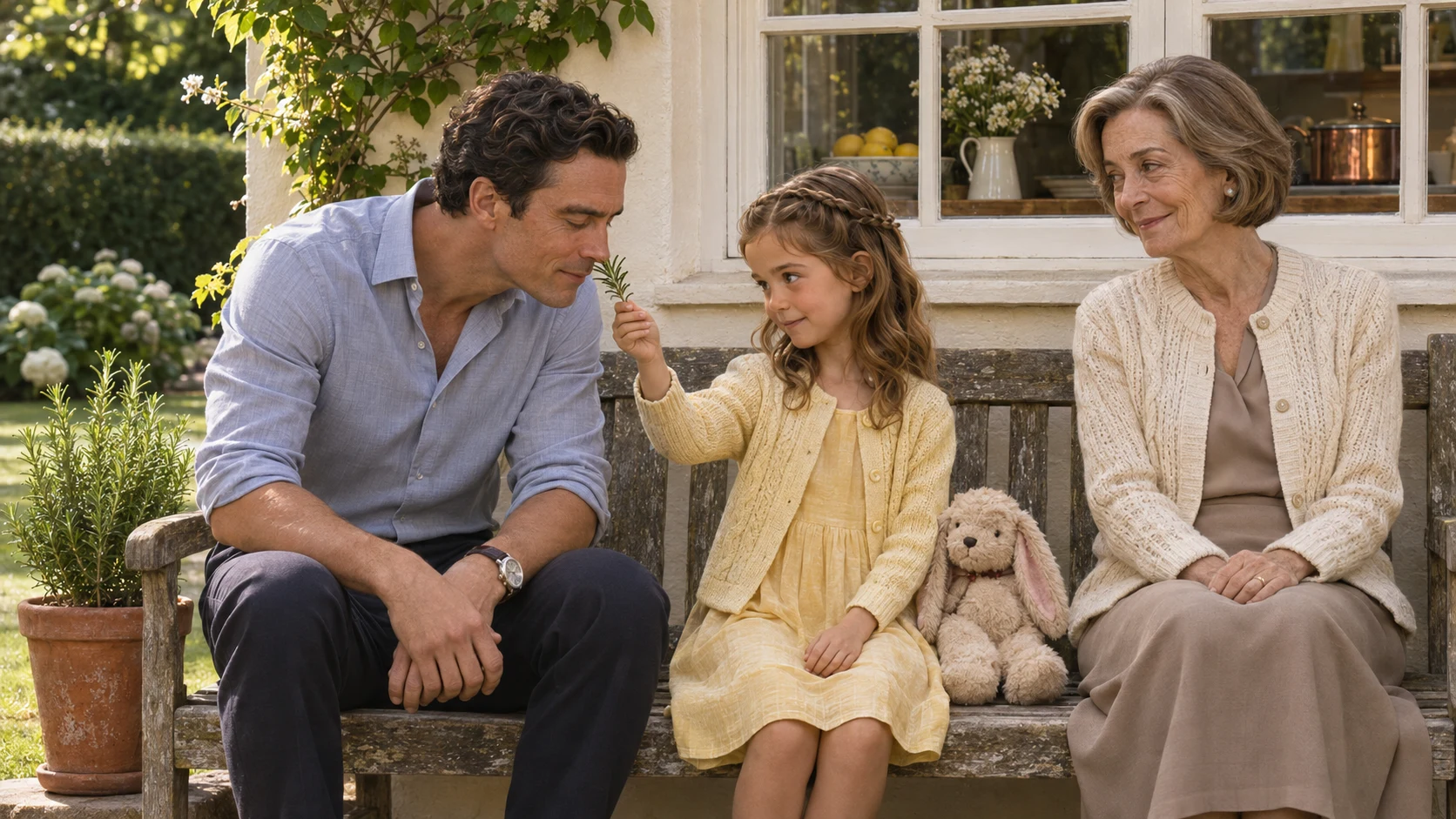
Outside, the rosemary had grown woody in its pot. There were brown leaves beneath the green ones, and a fine web stretched between one branch and the wall. Thomas had considered replacing it several times. He had never been able to decide whether leaving it was neglect or keeping it was love.
Lily sat in the middle of the bench. Margaret took one side. Thomas took the other.
For ten minutes, none of them spoke.
Then Lily leaned forward, reached past her father's knee, and broke a tiny sprig from the plant. She rubbed it between her fingers and held it toward him.
He breathed in the sharp green scent.
“I remember,” he said.
Lily put her head against his arm.
10. A Different Kind of Record
Thomas contacted the professional already supporting Lily and described the evening as accurately as he could. He included the spoken words, but he also described what had happened before them: the waiting, the open hands, the absence of a repeated question.
Then he described breakfast and the bench.
He had once measured the week by the thing that had not happened. Now he began keeping a different kind of record. Lily had corrected Margaret's guess. She had requested time outside. She had greeted him with a raised hand. She had chosen where to sit.
These were not substitutes for a child he was waiting to get back. They were things his child was doing now.
The guidance they received did not turn the gala into a treatment plan or promise that one moment predicted another. They continued their existing support and discussed how to make everyday communication feel less pressured. Thomas asked more practical questions than he had before.
How could he offer choices without making every meal an interview? How could relatives be kind without asking for a demonstration? How could he tell people about Lily while keeping her private life hers?
Margaret wrote some of the answers down. Then she crossed out the heading she had put at the top of the page, THINGS TO GET LILY TALKING, and replaced it with THINGS WE CAN CHANGE.
She showed Thomas the correction over tea.
“That seems fairer,” he said.
They made a small basket for the kitchen table: blank cards, pencils, and a few simple picture choices. Lily inspected it, removed a pencil with a broken point, and added a small notebook of her own.
Thomas did not ask why. Two days later, she used the notebook to show him a picture of the library.
They went that afternoon.
At the desk, a librarian asked Lily whether she wanted to borrow the book she was holding. Thomas felt the old answer rise in him. He waited instead.
Lily placed the book on the counter and pushed her library card beside it.
“Excellent choice,” the librarian said, and began the checkout.
Nothing remarkable happened. No one turned to stare. Thomas carried that ordinary exchange home like something fragile and valuable.
That evening, he sent Nora a short message. He told her they had sat on the bench. He did not send a recording of Lily or ask whether she thought the morning's silence was a bad sign.
Nora replied that she was glad they had made time for the garden.
Lily saw her name on the screen and tapped it once.
“Would you like me to say hello from you?” Thomas asked.
Lily nodded, then drew a tiny rabbit in the notebook and held it up for him to photograph.
11. The Second Visit
Nora came for tea the following Sunday after Thomas asked Lily and received an unmistakable nod. There was no surprise entrance, no arrangement designed to recreate the reception. Thomas explained when she would arrive and let Lily choose whether to stay downstairs.
When the doorbell rang, Lily waited beside the staircase with Button under her arm.
Nora wore a simple coat over her green dress. She did not bring a gift that needed an excited response. She brought herself, a little early because the bus had been faster than expected, and an apology for the timing that made Margaret smile.
Lily pointed toward the sitting room.
“Thank you,” Nora said. “You can show me.”
The little girl led her to a chair near the window. On the table were four cups and a plate of biscuits. Lily moved one cup to the other side of the plate before sitting down.
Nora accepted the rearrangement without comment.
For the first few minutes, Thomas talked too much. He heard himself explaining the weather, the bus route, the history of the house. Margaret gave him a look over her cup. He stopped and laughed softly at himself.
“I'm still learning how to leave a little room,” he admitted.
“Most of us are,” Nora said.
Lily took out her notebook. She opened it to a drawing of the gala staircase, complete with a large chandelier and small dots for the crowd. Four figures stood near the bottom. One was lower than the others.
Nora studied it. “That's where we met.”
Lily nodded and touched the kneeling figure.
“Me?”
Another nod.
Lily turned the page. This drawing showed the garden bench. The three figures were close together, and the rabbit had been given unusually large ears. A small cloud floated above them, filled with short pencil marks.
“Rain?” Thomas asked, then caught himself. “I'm guessing. You can show me.”
Lily shook her head. She pointed at the rosemary through the window and rubbed her fingertips together.
“The smell,” Margaret said slowly.
Lily smiled.
They sat with that discovery. The cloud was something invisible made visible. Lily had found a way to put a memory on paper without having to explain why it mattered.
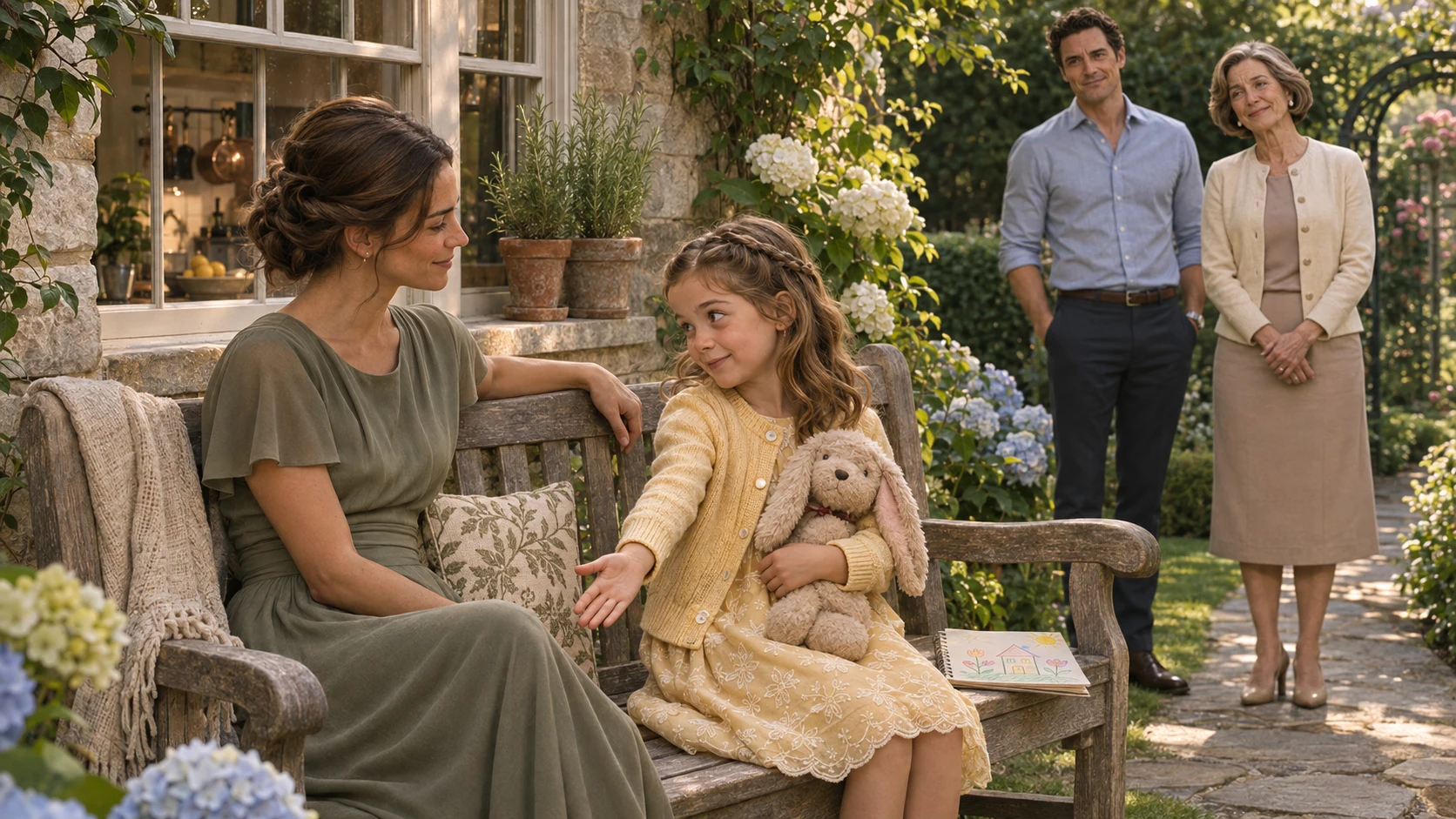
After tea, Nora asked to see the garden. Lily carried the notebook outside and showed her the bench. Thomas stayed a few steps behind, close enough to be there and far enough not to turn the moment into an inspection.
Lily looked at the empty place beside her.
“Sit here,” she said.
Nora sat.
Thomas looked at Margaret. Neither moved forward. Neither asked for the words again.
12. What the Room Finally Heard
There were other words after that Sunday, and there were quiet days between them. Sometimes Lily spoke at home and used the notebook outside. Sometimes she changed her mind halfway through a sentence. Sometimes she became frustrated when an adult guessed too quickly, and sometimes she wanted help finishing.
Thomas learned to ask which kind of help she wanted.
He did not get it right every time. One evening, tired after work, he answered a question for her at dinner and saw her face close. He stopped, apologized, and gave the conversation back. An apology could not undo the interruption, but it could show her that adults were allowed to notice and change.
Margaret learned a different lesson. She had thought encouragement meant making every effort visible. Now she saved some of her delight for later, when Lily was not carrying it. She could be proud without turning pride into an audience.
The rabbit remained part of the family. Its ribbon frayed. A seam opened beneath one arm, and Lily brought it to Margaret with the sewing box. They repaired it together at the kitchen table, Lily choosing the thread and Margaret making the stitches small enough to disappear into the fur.
Nora visited when she could. Sometimes weeks passed between visits. She was not summoned whenever a difficult day arrived, and she did not become responsible for preserving the words she had happened to hear first.
What grew between them was ordinary friendship, given room to become itself.
Months later, the family support center held a small afternoon gathering in its garden. There was no orchestra, no staircase, and no marble floor bright enough to reflect a person back at herself. Children moved between tables while adults tried to keep paper cups from tipping in the breeze.
Lily chose a yellow cardigan and brought Button. In her notebook, she had drawn a flower with a long stem and uneven petals. She gave the picture to Nora, then went to help Margaret arrange biscuits on a plate.
Thomas stood beside Nora and watched his daughter disagree politely about where the chocolate ones belonged.
“I kept asking who you were,” he said. “That night. In my head.”
Nora smiled. “I was mostly someone trying to find a quiet corner.”
“I thought you must know something no one else knew.”
“Did you decide what it was?”
Thomas looked toward Lily. She had put the chocolate biscuits in a separate row and was pointing out the arrangement to Margaret, who listened with exaggerated seriousness until Lily laughed.
“I think you reminded us that she was already there,” he said.
Nora did not claim the explanation. She watched Lily reach for a paper napkin and carefully wipe a spot of chocolate from the rabbit's paw.
At the gala, Thomas had heard a voice he feared he had lost. In the months afterward, he learned to hear the choices, gestures, refusals, drawings, and pauses that had been reaching him all along.
Lily looked up from the table and lifted her hand.
He lifted his back.
Then he waited to see what she wanted to tell him.